
Aquinas v. Spencer
according to Sr. Fides Shepperson, PhD

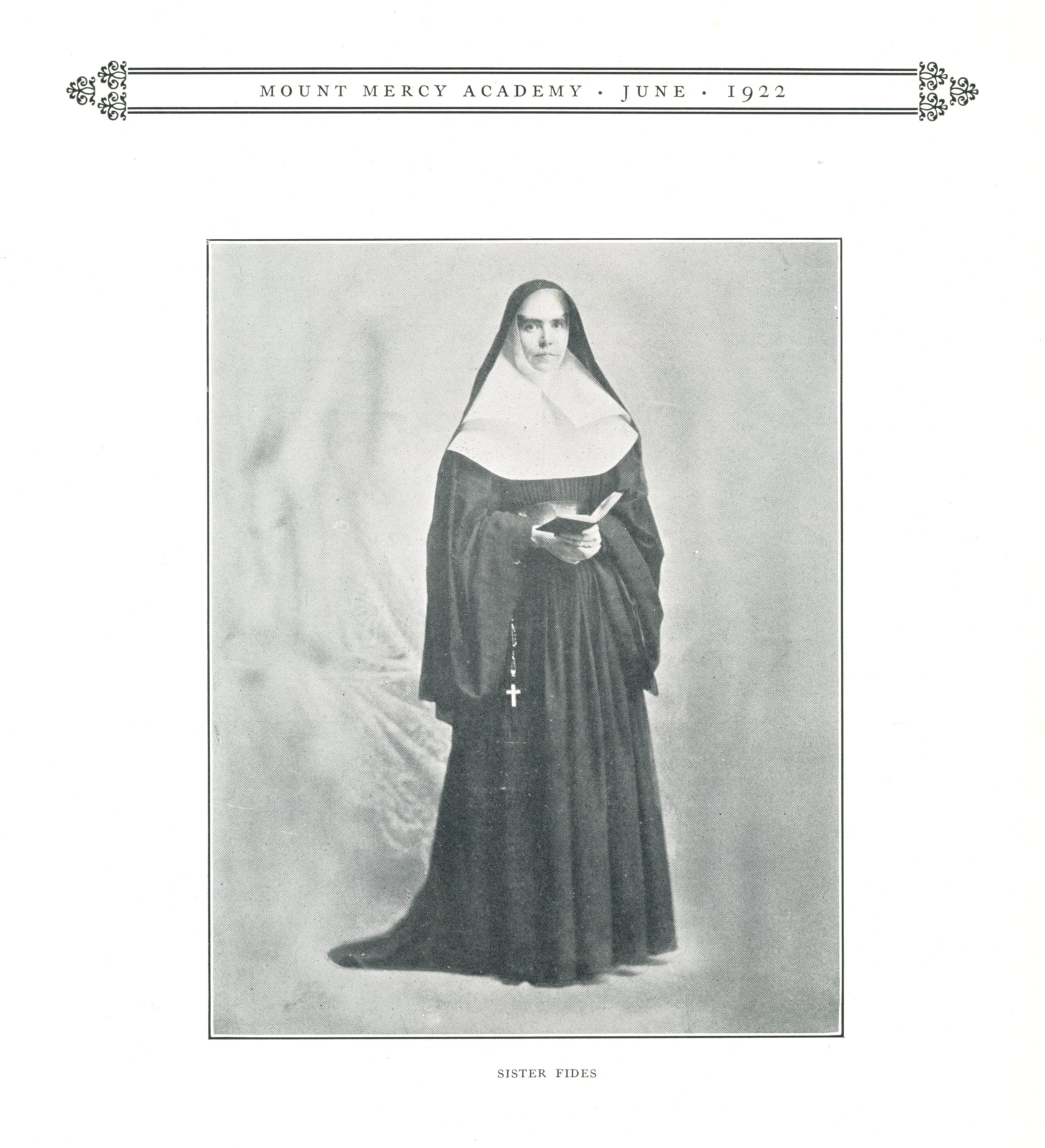
On May 16 of last year, I posted a short piece on Sister M. Fides Shepperson, RSM (1867-1952), a convert to Catholicism at age 18. Thanks to material held at the archives of the Sisters of Mercy, Carlow University (formerly Mount Mercy College), Duquesne University, and the University of Pittsburgh, I am deep into researching her biography. Today, I’m sharing one item from my study—a glimpse of her doctorate dissertation. She was the first woman to earn a doctorate in philosophy from the University of Pittsburgh (1923).
Herbert Spencer, the English philosopher, evolutionist, and coiner of the phrase “survival of the fittest,” died in 1903. Sister Fides was 36 in 1903 and, voracious reader that she was, was familiar with Spencer’s writing. In her formation as a religious sister (she entered in 1888) she read works by Thomas Aquinas, saint and doctor of the Church. She brought the two thinkers together for her 79-page dissertation, A Comparative Study of St. Thomas Aquinas and Herbert Spencer. It’s a fascinating read.
To illustrate the differing cultures in which the two men lived, she opened with a chapter with a fusion of horizons contrasting the countries of Europe in the thirteenth century with the nineteenth century.
Next, she contrasted “the ultimate Reality” according to each, followed by a chapter questioning the knowability or unknowability of the ultimate Reality. Here she proposes “the ultimate Reality, or God, is, according to Aquinas, inadequately known,” and according to Spencer, “the ultimate reality, or Absolute, is unknown and unknowable.”
In the fourth and final chapter she compares “the Genesis and Genetic Processes of the universe according to (a) Aristotle-Aquinas, and (b) Spencer.”
In her recapitulation she claims “Both Aquinas and Spencer claim that there can be but one order of truth. Religion, Reason, and Science cannot fundamentally conflict,” and that “Aquinas and Spencer did not differ fundamentally in their philosophical outlook upon phenomena; they differed in their attitude of mind toward Life — in its origin, its meaning, its end. This difference is a matter of theological discussion, — not of philosophical.”
She concludes with the following aggregation:
“In brief summation: Aquinas and Spencer both recognize (a) that there exists an inscrutable Power — Cause and Conserver of the universe; (b) that this Power is, in some measure, known to us through its phenomenal effects; (c) that truth is unitary: Religion, Reason, and Science are fundamentally in accord.”
Sister Fides was a prolific writer—philosopher, theologian, poet.
One more thing: reading her dissertation reminded me of Jack London and his semi-autobiographical novel, Martin Eden. In it, Martin Eden is influenced by and eventually led by Spencer’s writing—he quotes Spencer at length. I don’t think Eden would countenance Aquinas. London and Shepperson were contemporaries, though London died in 1916 at age 40. Had he lived I can imagine a mid-1920s debate between the two—the novelist taking Spencer’s side, and the nun her own. My money is on the good sister.
You are wise beyond your years Mr. Jim Hanna. The proof of that wisdom shines forth in your decision to choose the side of the good sister over that of the hard living London. A choice I learned very early in life from the Good Sisters of Mercy who ruled at St. Elizabeth of Hungary grade school, forcefully guiding and shaping young minds to be able to see the light (or in extreme cases, even feel the light).