
Is baseball holy?

“Is baseball holy?” That’s a question the character named Peter the Saint asks of a clergyman in Pull my Daisy, the 1959 film featuring Beat poets Allen Ginsberg, Gregory Corso, and Peter Orlovsky. It was adapted by Jack Kerouac from the third act of his play, Beat Generation.
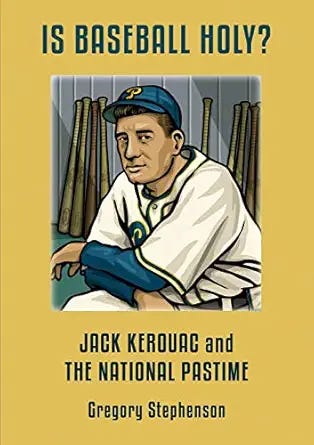
It’s also the title of a pamphlet sized book written by Beat scholar Gregory Stephenson, published in 2021, and subtitled Jack Kerouac and the National Pastime.
And it’s a question answered by many quoted by Stephenson.
“The magical qualities of primitive religion exist in baseball … a sport that partakes of the divine and transcendent.” —George Grella
“Baseball commands religious respect because its rituals and symbols manifest an underlying mythology that should be called religious.” —Michael Butterworth
(There is) “a spirituality embedded in the game … baseball embodies lessons about values and morality (that) can lead to experiences that are pivotal and transformative and provides an avenue for transcendence.”—Gary Laderman
“Baseball has the capacity to both elevate and transform … gives us a sense of the ineffable, the transcendent.”— John Sexton
Stephenson proposes that a baseball game may be seen as “a Christian allegory, a kind of improvised Miracle Play with eighteen actors.” In making his case, in addition to the above, he quotes Daniel McNeil’s Baseball Metaphysics, Marvin Cohen’s Baseball as Metaphysics, and David Bentley Hart’s A Perfect Game: The Metaphysical Meaning of Baseball.
And he notes John Updike’s 1956 poem “Tao in the Yankee Stadium Bleachers.”
What does Kerouac have to do with this, aside from the question posed in his play? Stephenson’s book answers this in detail of course, but three things to know.
(1) Kerouac was an athlete who excelled at football (I’ve written about Kerouac’s gridiron glory here), track, and baseball as a youngster growing up in Lowell, Massachusetts.
(2) He invented a fantasy baseball game that he maintained and played for many years, assigning himself as manager of the fictitious Pittsburgh Plymouths.
(3) Baseball is a theme Kerouac explores in many of his novels, essays, and haiku.
Stephenson’s book is an interesting and fun read that points to specific instances in Kerouac’s oeuvre where the writer portrays baseball in a way that lends to the game a measure of holiness.
In searching Kerouac’s baseball-playing days, the first reporting I uncovered is a 1938 article and box score (Lowell Daily Sun, July 18, 1938) of a doubleheader where Jack, age 16, played left field for the A & P All-Stars of the Pawtucketville League. In the first game Kerouac went 0 for 3, had 1 put-out, and scored one run as his team beat Scott’s Rex Wine 3-2. The second game saw the A & P losing to the Wannalancits 1-0. Jack went 1 for 4 at the plate. The speedy Kerouac had a stolen base in each game and was error-free in the field.

Great stuff!